
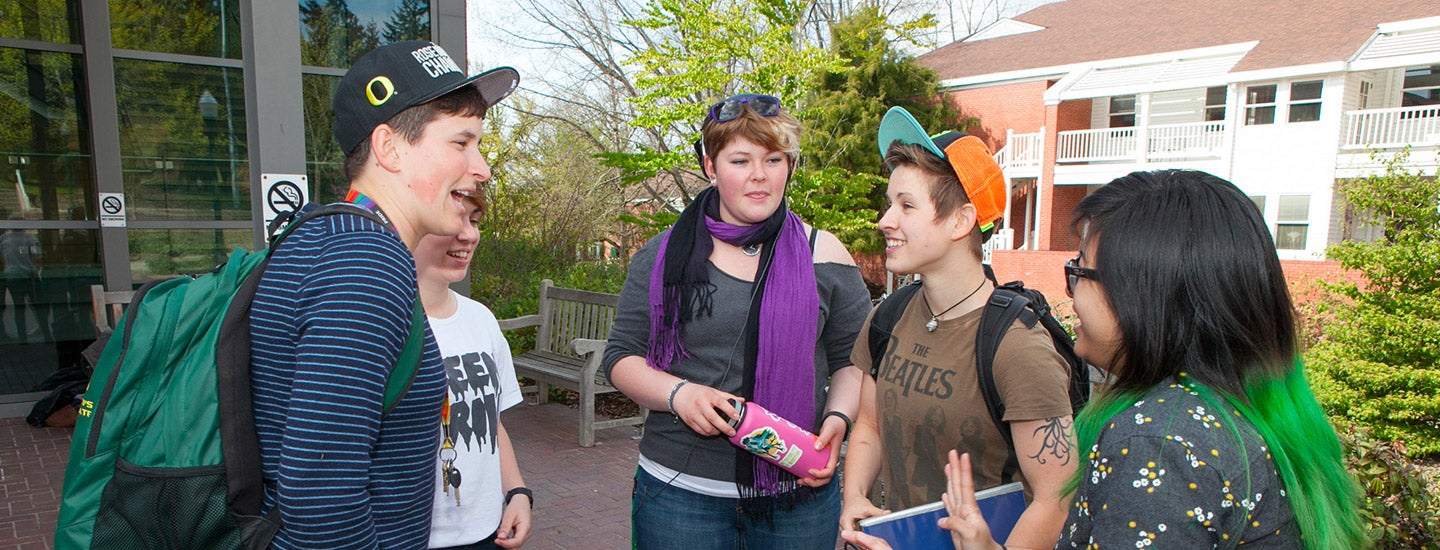
Education and Support Services (LGBTESS)
The mission of LGBTESS is to promote a safe, equitable, accessible, and affirming campus for Two-Spirit, lesbian, gay, bisexual, transgender, queer, questioning, intersex, asexual, aromantic, and agender (2SLGBTQIA3+) students at the University of Oregon through resource navigation, education, community building, and event implementation.
Lavender Graduation Celebration 2026
Sunday, June 14 | 10:30 a.m.–12:30 p.m. | EMU Ballroom
Doors open and food served at 10:00 a.m. Program begins at 10:30 a.m.
Graduating 2SLGBTQIA3+ students who wish to be honored at the celebration should respond by end of day on May 25, 2026. Open to all graduating students.
Connect with LGBT+ Education and Support Services
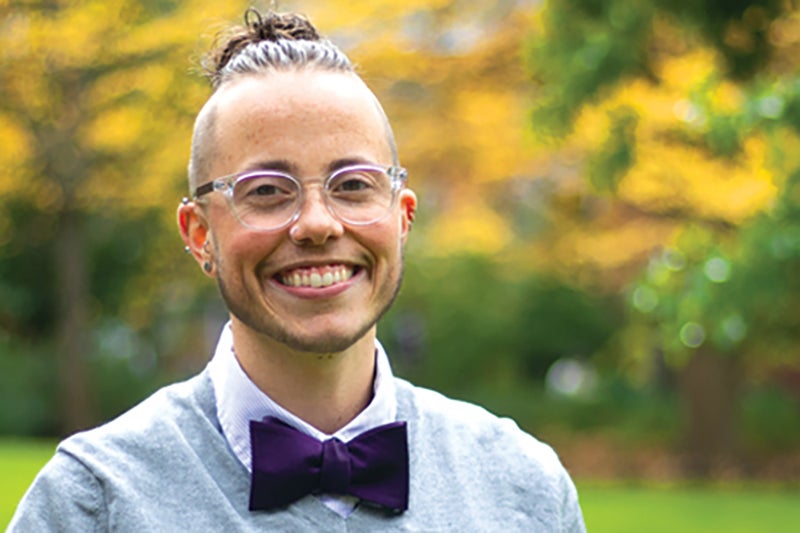
SJ
Program Director, LGBT Education and Support Services
To schedule a meeting with SJ, please email sjwil@uoregon.edu.
Monday–Friday: 9:00 a.m.–5:00 p.m.
Located in Oregon Hall, Suite 380
- Email lgbtess@uoregon.edu for questions about LGBT Education and Support Services events and initiatives.
- Email lgbtessentials@uoregon.edu for questions about food and/or housing insecurity and accessing healthcare.
- Email uooutreach@uoregon.edu for questions about on- and off-campus resources and community.
- Email qtgrads@uoregon.edu for questions about 2SLGBTQIA3+ graduate student support.
Events
3:30–5:00 p.m.
The Center for Latino/a and Latin American Studies (CLLAS) is pleased to host a research colloquium featuring faculty and graduate student scholars whose work explores how migration, embodiment, environment, and cultural production shape Latine experiences of belonging. Through literature, media, performance, and critical theory, this event highlights interdisciplinary approaches to identity, place, and community across Latinx and Latin American contexts.
Salomé Herrera, PhD, is a faculty member in the Department of English at the University of Oregon whose research is rooted in literary, performance, and Latinx studies. In their talk, "Trans* Epistemologies: Tracing the Womb across the Gloria Evangelina Anzaldúa Papers," Herrera traces an embodied trans* epistemology across the Gloria Evangelina Anzaldúa Papers from the Benson Library at the University of Texas at Austin. They specifically examine the development of Anzaldúa’s conceptualization of “el cenote,” Mexican lime hole sinkholes with spiritual significance for Mayan cultures, understood as material reservoirs or “wombs” of the collective unconscious from which creativity emerges. Drawing across spiritual and materialist traditions, Herrera shows how a sense of transitivity emerges from a queer Chicana feminist understanding of evolution, ultimately arguing that Anzaldúa’s speculative world-building transforms the womb from a colonized site of carceral policing into one of communal creativity with decolonial potential.
Alejandro Marín is a doctoral candidate in the Department of Romance Languages at the UO whose research focuses on contemporary migrant narratives from Cuba, the Dominican Republic, and Equatorial Guinea. His dissertation, "The New Errancy: Configurations of Contemporary Migrant Literature in Cuba, the Dominican Republic, and Equatorial Guinea," develops “The New Errancy” as an analytical category to examine how authors from three distinct migration contexts challenge traditional colonial axes, reimagine non-biological family formations, and construct transnational identities in solidarity with contemporary migrants. Supported by the CLLAS Graduate Research Grant, Marín conducted archival research in the Dominican Republic, interviewed author José Acosta, and observed cross-border dynamics at Dajabón, grounding his work in lived migration contexts. The chapter he presents reads Loida Maritza Pérez’s Geographies of Home as a meditation on how transnational Dominican families negotiate generational fracture, linguistic displacement, and the contested meaning of belonging between the island and the United States.
Moe Gámez is a doctoral student in the Department of English at the UO whose research explores the intersection of Latinx literature, environmental justice, and queer/trans theory. Their dissertation examines how queer and trans Latinx authors and artists represent ecologies through embodied, speculative, and political narratives. Through archival and literary analysis, Gámez’s work contributes to the growing subfield of queer and trans Latinx environmentalisms, highlighting how questions of environment, identity, and embodiment are deeply interconnected.
Together, these scholars offer interdisciplinary perspectives on how Latine communities and cultural producers negotiate identity, space, embodiment, and belonging in relation to migration, ecology, and social transformation. Please join us for this engaging conversation and opportunity to learn more about emerging faculty and graduate student research at the UO. This event is presented by the Center for Latino/a and Latin American Studies.
5:00–7:00 p.m.
Weaving Hope represents an opportunity for queer and trans stories of recovery from substance misuse to reach a wider public. The first event of its kind at UO, this event will bring together queer and trans individuals from UO, the Eugene area, and beyond to share unique stories focused on how substance misuse impacts our communities, and how we have survived and thrived in the face of addiction.
6:00–8:00 p.m.
Join the OP's collaborative program coordinators (Avery & Ari) for a clinic at the OP Barn on May 20th to learn the process of proposing and planning an outing or event through our Redefining Outdoorsy Program.
The UO Outdoor Programs Redefining Outdoorsy Program (RO) is designed to intentionally shift outdoor culture by highlighting and reducing barriers of entry to outdoor spaces, events, trips, and outings for those who identify in underrepresented groups in the outdoors and on campus. Our trips are designed to make an impact and support our community. If you are an indvisual or part of a group on campus (such as but not limited to NASU, LGBTQIA, BIPOC, etc) and want to learn more about how the RO program can get you or your group outside come to our RO Clinic!
We'll cover the steps you need to take to ensure that your outing goes off without a hitch. We can't wait to get outside with you!
No sign-ups needed just show up! Pizza wil be provided!
Who: UO students only
What: Redefining Outdoorsy Clinic
When: May 20th | 6 pm - 8 pm | Free
Where: At the OP Rental Barn off 18th and Univerity
11:00 a.m.–1:00 p.m.
Join us for the 2026 Military Connected Graduation Celebration on June 13, 2026 from 11 am – 1 pm in the Crater Lakes South room.
All graduating students are welcome to participate.
Graduating Students should registered using this link: https://oregon.qualtrics.com/jfe/form/SV_248irnJ0S14D4JU
*Please submit the form by May 25, 2026, at 11:59 p.m.
10:30 a.m.–12:30 p.m.
Join us for the 2026 Lavender Graduation Celebration on June 14, 2026 from 10:30 am – 12:30 pm in the EMU Ballroom. All graduating students are welcome to participate.
Graduating Students should registered using this link: https://oregon.qualtrics.com/jfe/form/SV_248irnJ0S14D4JU
*Please submit the form by May 25, 2026, at 11:59 p.m.
3:00–5:00 p.m.
Join us for the 2026 ¡Sí, se pudo! celebration on June 14, 2026 from 3:00 pm - 5:00 pm in the EMU Ballroom. All graduating students are welcome to participate.
Community & Belonging Programs is proud to partner with Latiné Strategies Group, Hispanic Serving Institution Task Force, Center for Latino/a and Latin American Studies, and MEChA to host the first ¡Sí, se pudo! (Latiné Grad Celebration), and we hope that you can join us in celebrating you and other graduating Latiné Diaspora students from the University of Oregon.
¡Sí, se pudo! celebrates the accomplishments and achievements of undergraduate, graduate, and law students who are Latiné, Hispanic, and/or of the Latinx Diaspora. This celebration commemorates the hard work and dedication that our students have shown throughout history, not only at the University of Oregon but also in global society.
*This will be a ticketed event
* Event will be live-streamed
*Time subject to change.
Graduating Students should registered using this link: https://oregon.qualtrics.com/jfe/form/SV_248irnJ0S14D4JU
*Please submit the form by May 25, 2026, at 11:59 p.m.
-
Speaker Nominations Form - Deadline: April 17th @ 5:00 pm (Self-nominations and nominations from peers, faculty, and/or staff are welcomed)
6:15–8:15 p.m.
Join us for the 2026 Black Graduation Celebration on June 14, 2026 from 6:15 pm – 8:15 pm in the EMU Ballroom. All graduating students are welcome to participate.
*Time subject to change
*Event will be live-streamed
Graduating Students should registered using this link: https://oregon.qualtrics.com/jfe/form/SV_248irnJ0S14D4JU
*Please submit the form by May 25, 2026, at 11:59 p.m.
-
Speaker Nominations Form - Deadline: April 17th @ 5:00 pm (Self-nominations and nominations from peers, faculty, and/or staff are welcomed)
noon
Create art as a form of self-expression as you explore the visual arts in the galleries and studio of the Jordan Schnitzer Museum of Art in this week-long afternoon art workshop for transgender and gender nonbinary youth in grades 5- 8. This week is supported by members of the transgender, non-binary, and queer community of artists, educators, students, and allies.
August 17-August 21, 2026, noon - 3:00 pm
Navigate Campus
We are committed to creating an equitable and accessible environment for students, whether that be via all-gender and gender-expansive housing options, name change processes, or all-gender restrooms.
Connect with Resources
Resources for 2SLGBTQIA3+ students encourage holistic well-being and academic success through mental, medical, and community care. Scholarships and other financial assistance are based on need and/or merit. Students are also invited to apply for LGBTESS-sponsored conferences. In addition to our programs and services, there are off-campus organizations dedicated to advocating and resourcing 2SLGBTQIA3+ folks.
Build Community
Our student-driven outreach teams celebrate, educate, empower, and support 2SLGBTQIA3+ students. Whether organizing events, developing new initiatives, or collaborating with campus organizations, one of the priorities of the LGBTESS staff is to support students in fostering community.
Support 2SLGBTQIA3+ Students
Effectively supporting 2SLGBTQIA3+ students is an on-going process which requires self-awareness, knowledge, and skills. LGBTESS hosts Queer+ Accomplice Coalition (QAC) training once a term to jump-start faculty and staff in this process and provides resources to support continued learning and advocacy practices.